By: Simona M Mocuta, Chief Economist
Three Fed dissents point to a gradual, pre-emptive tightening bias rather than urgency, while the BoE raises the bar for hikes and the BoJ’s FX intervention strengthens the case for Q4 normalization.
US: The dissents tell the story
The second FOMC meeting under the leadership of Chair Warsh was more edgy and triggered more market volatility. There was no change to the Fed Funds rate (still at the 3.50-3.75% range) but there were three dissents in favor of an immediate hike. Given the terseness of the FOMC statement (essentially unchanged from June), the individual statements put forth by the three dissenters offer more color on the question of policy direction.
Minneapolis Fed President Kashkari: “But to manage against the risk that high inflation could become entrenched, I would rather tighten policy incrementally as we gather more data on the path of inflation and employment. If inflation remains elevated, in my view, a potential series of small policy moves would be better than waiting and eventually concluding that even bolder actions were necessary. On the other hand, if inflation durably fades, a strategy of small policy steps would allow the FOMC to slow or pause subsequent adjustments without unnecessary impact on the real economy.”
Dallas Fed President Logan: “Labor, consumption and financial market conditions indicate that monetary policy is not restraining the economy. Without any policy restraint, inflation will likely continue to trend above target until there’s an unanticipated shock. The FOMC cannot count on unanticipated shocks to achieve its goals and can always adjust policy if unanticipated shocks occur. Modest action in the near term would reduce the likelihood of needing to take sharper action later.”
Cleveland Fed President Hammack: “A higher federal funds rate would help restrain economic activity and reduce inflationary pressures. I preferred to move at our recent meeting because I did not see the current policy stance as appropriately restrictive.”
The three excerpts above share a common thread: the idea that inflation is not convincingly trending toward the target and that policy is not sufficiently restrictive to make that happen. As such, some tightening is needed, and it is better to do it gradually. In other words, start early and go slow rather than wait and go fast. Critically, none of the dissenters appear to believe that the Fed is “behind the curve” and the tightening they seem to imply is still very much a pre-emptive kind of action. This is important because if even the hawks see tightening as pre-emptive, the majority of the FOMC members likely believe that there is still a window of time before rate hikes become compelling. And that window can bring about favorable data evidence that makes the hikes less, rather than more compelling over time. We continue to believe the Fed will just barely remain on hold this year.
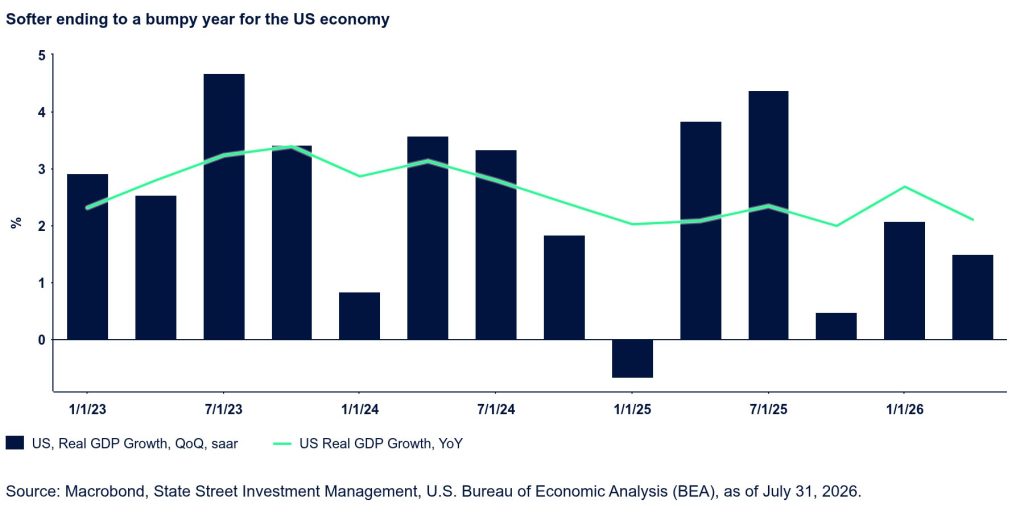
Meanwhile, advance estimates for second quarter GDP peg growth at a lower-than-expected 1.5% seasonally adjusted annualized rate (saar) (Figure 1). Private consumption made an outsized contribution, but the strength is partly financed by dissaving and partly boosted by the World Cup. Fixed investment was robust but with split performance across segments (strong equipment and IP, weak structures and residential). Trade was a sizable detractor. The data remains consistent with our 2.3% full-year GDP growth forecast.
BoE: On hold with hike bar rises
The BoE left rates unchanged at 3.75%, but its policy message mattered more than the decision itself. In our view, this was a dovish hold, with the bar for another hike now meaningfully higher.
At first glance, the vote split looked hawkish, with Mann joining Pill and Greene in backing tighter policy. But that signal should not be overread. The center of gravity on the MPC is shifting towards patience, reinforced by softer labor market and inflation data. While hawkish members can still point to upside risks, they now need much clearer evidence to make the case for renewed tightening.
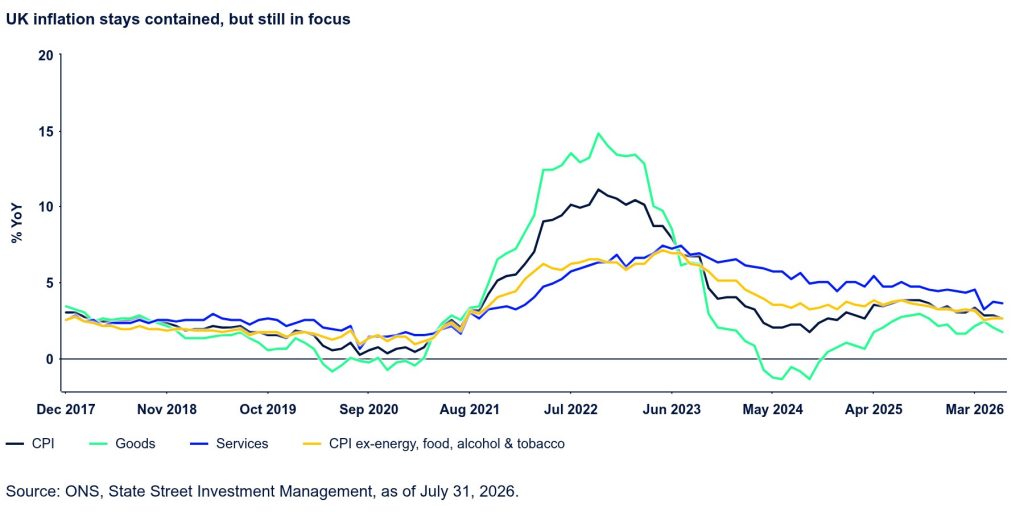
The reaction function is therefore key. The recent rise in energy prices has attracted the MPC’s attention, but energy volatility alone is unlikely to push the Bank back into tightening mode. For hikes to return, the BoE would need evidence that higher energy costs are feeding into wages, pricing behavior and inflation expectations. For now, that evidence remains limited. Business surveys point in the same direction: firms are not adjusting wage or price plans solely because of higher energy costs.
Taken together, this leaves policy asymmetric. Near-term inflation volatility may keep the BoE cautious on cuts, but without clearer signs of persistence, it is unlikely to justify restarting hikes.
Our base case is therefore for the BoE to stay on hold for now, before resuming cuts in Q2 next year.
BoJ: First joint intervention in 15 years
The Bank of Japan (BoJ) left its policy rate unchanged at 1.0%, with a neutral stance, maintaining a cautious but still hawkish stance. The decision was not unanimous, with board member Hajime Takata reportedly dissenting in favor of a 25 bp hike, underscoring growing concern within the Board about upside inflation risks. In its statement, the BoJ reiterated that underlying inflation is moving closer to its 2% objective and that accommodative financial conditions continue to support the economy. Importantly, the Bank emphasized that it would continue normalizing its monetary policy if its economic and price outlook materialize as expected.
The updated Outlook Report painted a broadly constructive picture of Japan’s economy. While growth is expected to moderate in FY2026 amid higher energy costs and uncertainty stemming from the Middle East, the BoJ believes the economy will remain supported by accommodative financial conditions, government measures, and robust global demand linked to AI investment. The most notable change was on inflation. The Bank now expects core CPI inflation to rise clearly above 2% during the second half of FY2026 before easing back toward target thereafter. The Bank highlighted several catalysts behind this view, including continued wage-price pass-through, elevated energy costs, yen depreciation, and rising semiconductor-related costs linked to strong global AI demand.
Governor Ueda’s press conference reinforced the message that inflation risks are increasingly tilted to the upside. He noted that several board members now see higher inflation risks and indicated that the BoJ could accelerate the pace of normalization if monetary conditions remain excessively accommodative. Of particular interest was his explicit reference to AI-related demand as a factor warranting close monitoring. Ueda argued that strong global AI investment is influencing demand conditions and could have broader implications for prices through semiconductors and related supply chains. On the currency, he stressed that yen volatility is having a larger impact on inflation than in the past and warned that policymakers must pay greater attention to exchange-rate-driven price pressures now that underlying inflation is much closer to target. His comments suggest the BoJ increasingly views yen weakness not simply as a market development but as a factor with direct implications for achieving price stability.
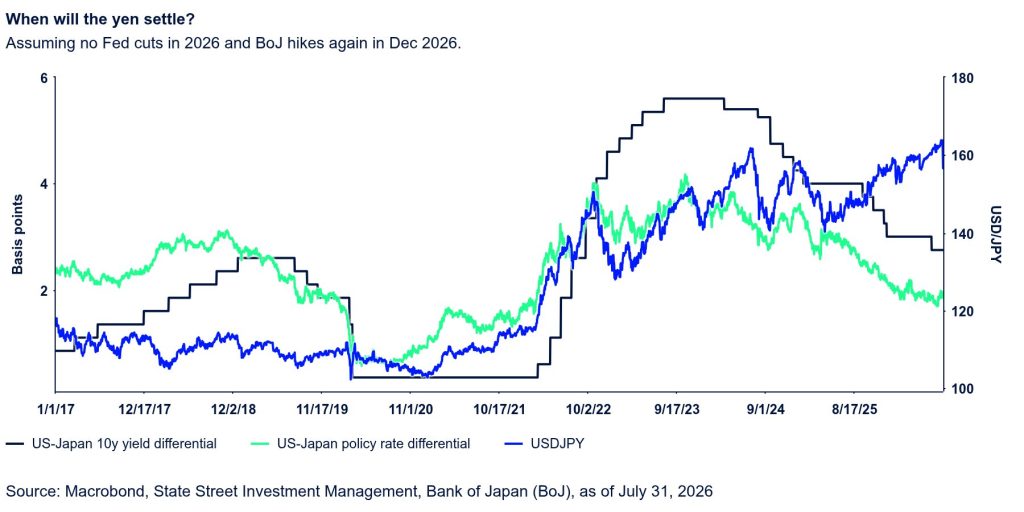
The yen remains the key risk to Japan’s inflation outlook and the clearest point of tension between policymakers and financial markets. Around the BoJ meeting, coordinated intervention by the Ministry of Finance and US authorities helped strengthen the yen to around 156.6 against the dollar by Monday noon. In our view, these interventions are significant because they highlight policymakers’ growing discomfort with the yen and reinforce the case for further policy normalization. As a result, we expect continued volatility, with the yen remaining highly sensitive to data flow, policy communications, and shifts in global rate expectations.
While a September rate hike cannot be ruled out, we view it at 25% probability. The case has strengthened nonetheless, given the yen’s renewed importance in the inflation outlook and the proximity of bank holidays around the September meeting. However, such an outcome would require a particularly supportive combination of domestic and global data, along with carefully coordinated guidance from policymakers in both countries. While the rationale is increasingly compelling, the hurdle for a September hike remains high.
More broadly, a divergence has emerged between rates and currency markets. Bond investors are increasingly recognizing that the BoJ is moving steadily along the path of policy normalization, while FX markets have been less convinced that the Bank will ultimately tighten enough to materially alter Japan’s interest rate differential with the rest of the world. We believe this skepticism underestimates the BoJ’s commitment to normalization. The Bank has consistently prepared markets for each stage of the process and remains firmly in control of the pace and direction of policy. This gap in expectations is narrowing as a result of the coordinated interventions, but the market may react sharply to data flow and guidance from policymakers.
Overall, this week’s decision does little to alter our baseline view. While the BoJ opted to pause, the combination of upside inflation risks, resilient domestic demand, ongoing wage gains, and an AI-driven boost to investment activity remains consistent with a gradual normalization cycle. The tone of both the statement and Governor Ueda’s remarks suggests that policymakers are becoming more confident that inflation can be sustained around target. As such, we continue to expect the BoJ to remain firmly in the driver’s seat and retain our forecast for another rate hike in Q4 2026, most likely once policymakers gain more confidence that recent inflation pressures are translating into durable underlying price momentum.
Originally published on Aug 3. 2026 on SSGA blog
PHOTO CREDIT: https://www.shutterstock.com/g/Freedomz
VIA SHUTTERSTOCK
DISCLOSURES
Marketing Communication
Important Risk Information
Investing involves risk including the risk of loss of principal.
All information is from SSIM unless otherwise noted and has been obtained from sources believed to be reliable, but its accuracy is not guaranteed. There is no representation or warranty as to the current accuracy, reliability, or completeness of, nor liability for, decisions based on such information, and it should not be relied on as such.
The information provided does not constitute investment advice and it should not be relied on as such. It should not be considered a solicitation to buy or an offer to sell a security. It does not take into account any investor’s particular investment objectives, strategies, tax status or investment horizon. You should consult your tax and financial advisor.
The trademarks and service marks referenced herein are the property of their respective owners. Third party data providers make no warranties or representations of any kind relating to the accuracy, completeness or timeliness of the data and have no liability for damages of any kind relating to the use of such data.
The whole or any part of this work may not be reproduced, copied, or transmitted or any of its contents disclosed to third parties without SSIM’s express written consent.
The views expressed in this material are the views of SSIM Economics Team through the period ended July 31, 2026, and are subject to change based on market and other conditions.
This document may contain certain statements deemed to be forward-looking statements. All statements, other than historical facts, contained within this document that address activities, events or developments that SSIM expects, believes or anticipates will or may occur in the future are forward-looking statements. These statements are based on certain assumptions and analyses made by SSIM in light of its experience and perception of historical trends, current conditions, expected future developments and other factors it believes are appropriate in the circumstances, many of which are detailed herein. Such statements are subject to a number of assumptions, risks, uncertainties, many of which are beyond SSIM’s control. Please note that any such statements are not guarantees of any future performance and that actual results or developments may differ materially from those projected in the forward-looking statements.
The information contained in this communication is not a research recommendation or ‘investment research’ and is classified as a ‘Marketing Communication’ in accordance with the Markets in Financial Instruments Directive (2014/65/EU) or applicable Swiss regulation. This means that this marketing communication (a) has not been prepared in accordance with legal requirements designed to promote the independence of investment research (b) is not subject to any prohibition on dealing ahead of the dissemination of investment research.
Intellectual Property Information
BLOOMBERG®, a trademark and service mark of Bloomberg Finance L.P. Standard & Poor’s S&P 500 Index® is a registered trademark of Standard & Poor’s Financial Services LLC. FTSE 100® is a trademark jointly owned by the London Stock Exchange Plc and The Financial Times Limited, and is used by FTSE International Limited under license. “All-World”, “All-Share” and “All-Small” are trademarks of FTSE International Limited.