By:
Tony Warburton, CFA, PhD, Head of Active Portfolio Management
Global equity markets have spent much of the past two decades moving to the rhythm of big macro narratives: inflation, interest rates, geopolitics, and artificial intelligence (AI). These forces still matter. But beneath the index-level story, a different pattern is emerging. Stocks are no longer moving together to the same degree, while the gap between winners and losers has widened sharply. For active investors, that combination matters. It suggests a market in which company-specific fundamentals may once again have more room to drive returns.
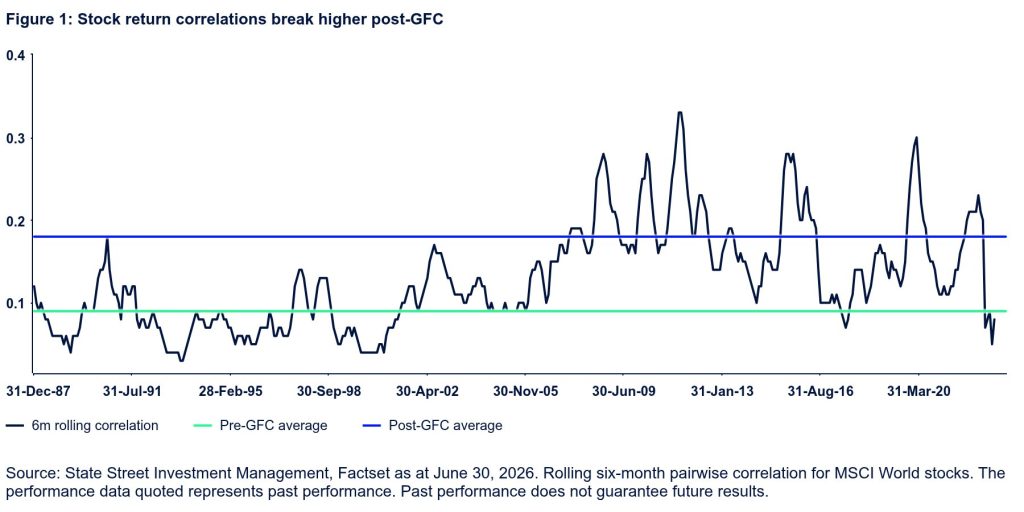
For much of the period following the Global Financial Crisis, market behavior was dominated by a succession of macroeconomic regimes. Quantitative easing, sovereign debt crises, the pandemic, inflation shocks, and the most aggressive rate-hiking cycle in decades encouraged investors to take a top-down approach. Stock return correlations noticeably broke higher (Figure 1) and success often depended on correctly forecasting growth, inflation, or monetary policy rather than identifying the individual companies with the strongest prospects.
Today, that dynamic appears less dominant. The evidence can be seen in two measures of market structure: cross-sectional dispersion and pairwise stock correlations since the market lows at the end of 2022 (Figure 2). Put simply, stocks are behaving less like a single trade and more like a collection of individual businesses. That is an important distinction. Low correlation means company returns are moving more independently. High dispersion means the reward gap between winners and losers is larger.
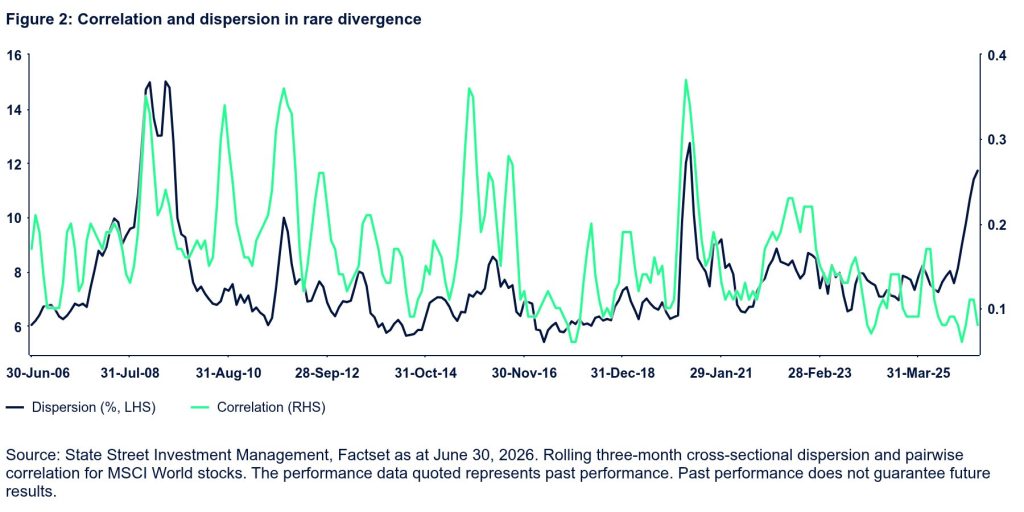
The current combination is striking. Dispersion has risen to one of the highest levels observed over the past two decades, while correlations remain close to the lower end of their historical range. This combination is unusual. High dispersion alone is not especially informative; periods of market stress often produce larger performance differences between stocks, and peaks in dispersion often coincide with market dips, as well as high correlations (Figure 3).
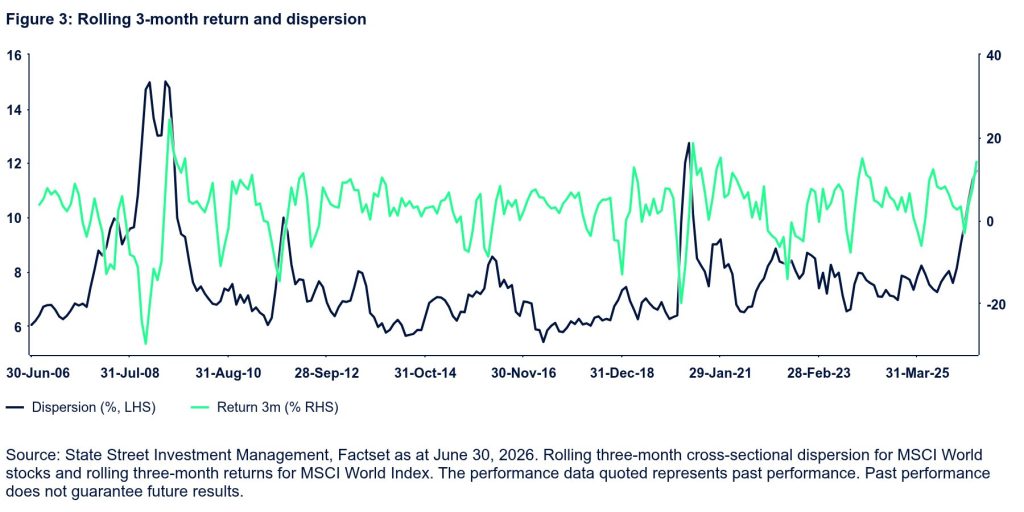
That is not what we are observing today. Instead, stocks are increasingly behaving independently from one another. Investors appear willing to reward some companies while penalizing others, creating a much wider range of outcomes beneath relatively stable index returns. In other words, markets are becoming more selective.
Macro still matters, stock selection matters more
This does not mean macro has stopped mattering. Interest rates, inflation, policy uncertainty, and geopolitics will continue to shape the market backdrop. Nor does it mean that index-level returns are irrelevant. But it does suggest that broad narratives may be less capable of overwhelming company-specific outcomes than they were in previous years. Investors appear more willing to reward companies with improving fundamentals, stronger earnings resilience, or credible catalysts, while punishing those where expectations look stretched or execution is weaker.
For active investors, this distinction is important. When stocks move together, market direction dominates and security selection has less room to influence outcomes. When the gap between winners and losers widens and stocks move more independently, selection becomes more valuable. But the opportunity cuts both ways. Higher dispersion increases the reward for being right, but it also raises the cost of being wrong.
That is why we believe the current environment favors a disciplined, diversified approach rather than simply taking more active risk. A broader opportunity set is only useful if investors can assess it consistently, avoid overreliance on any single theme and control unintended exposures. In our systematic active equity process, we seek to identify companies with attractive combinations of valuation, quality, sentiment, and catalysts, while explicitly managing portfolio risk. As markets become more differentiated, breadth matters: across stocks, across regions, and across multiple drivers of return.
We are not calling for a return to the Great Moderation. Macroeconomic uncertainty remains elevated and markets will continue to react to political and economic developments. But beneath those headlines, stocks are increasingly trading on their own merits. For investors willing to look beyond the index and into the cross-section of opportunities, this may prove to be one of the most fertile environments for active stock selection in recent years.
Originally posted on July 17, 2026 on SSGA blog
PHOTO CREDIT: https://www.shutterstock.com/g/Cordova+Creative
VIA SHUTTERSTOCK
DISCLOSURES
Marketing Communication
State Street Global Advisors (SSGA) is now State Street Investment Management. Please click here for more information.
State Street Global Advisors Worldwide Entities
The information contained in this communication is not a research recommendation or ‘investment research’ and is classified as a ‘Marketing Communication’ in accordance with the applicable regional regulation. This means that this marketing communication (a) has not been prepared in accordance with legal requirements designed to promote the independence of investment research (b) is not subject to any prohibition on dealing ahead of the dissemination of investment research.
This communication is directed at professional clients (this includes eligible counterparties as defined by the appropriate EU regulator) who are deemed both knowledgeable and experienced in matters relating to investments. The products and services to which this communication relates are only available to such persons, and persons of any other description (including retail clients) should not rely on this communication.
The information provided does not constitute investment advice and it should not be relied on as such. It should not be considered solicitation to buy or an offer to sell a security. It does not take into account any investor’s particular investment objectives, strategies, tax status or investment horizon. You should consult your tax and financial advisor.
All information is from State Street Investment Management unless otherwise noted and has been obtained from sources believed to be reliable, but its accuracy is not guaranteed. There is no representation or warranty as to the current accuracy, reliability or completeness of, nor liability for, decisions based on such information and it should not be relied on as such.
This document contains certain statements that may be deemed forward-looking statements. Please note that any such statements are not guarantees of any future performance and actual results or developments may differ materially from those projected. Investing involves risk including the risk of loss of principal.
The trademarks and service marks referenced herein are the property of their respective owners. Third party data providers make no warranties or representations of any kind relating to the accuracy, completeness or timeliness of the data and have no liability for damages of any kind relating to the use of such data.
The views expressed are the views of the Systematic Equity – Active team through June 17, 2026, and are subject to change based on market and other conditions.
Quantitative investing assumes that future performance of a security relative to other securities may be predicted based on historical economic and financial factors, however, any errors in a model used might not be detected until the fund has sustained a loss or reduced performance related to such errors.
State Street Investment Management uses quantitative models in an effort to enhance returns and manage risk. While State Street Investment Management expects these models to perform as expected, deviation between the forecasts and the actual events can result in either no advantage or in results opposite to those desired by State Street Investment Management. In particular, these models may draw from unique historical data that may not predict future trades or market performance adequately. There can be no assurance that the models will behave as expected in all market conditions. In addition, computer programming used to create quantitative models, or the data on which such models operate, might contain one or more errors. Such errors might never be detected, or might be detected only after the Portfolio has sustained a loss (or reduced performance) related to such errors. Availability of third-party models could be reduced or eliminated in the future.
Investing in foreign domiciled securities may involve risk of capital loss from unfavorable fluctuation in currency values, withholding taxes, from differences in generally accepted accounting principles or from economic or political instability in other nations.
Investments in emerging or developing markets may be more volatile and less liquid than investing in developed markets and may involve exposure to economic structures that are generally less diverse and mature and to political systems which have less stability than those of more developed countries.
Investments in small-sized companies may involve greater risks than in those of larger, better known companies.
The past performance data quoted represents past performance. Past performance does not guarantee future results.
Investing involves risk including the risk of loss of principal.
Equity securities may fluctuate in value and can decline significantly in response to the activities of individual companies and general market and economic conditions.