By:
Kevin Flanagan, Head of Investment and Fixed Income Strategy
Maggie Lucier, Senior Associate, Investment Strategy
Key Takeaways
- Artificial intelligence (AI) and tech concerns have renewed safe-haven demand for Treasuries, helping lower yields even as the pressures that drove them higher persist.
- The recent 40-basis-point decline in the 10-year Treasury yield has left yields at higher lows, with absolute levels still elevated.
- Solid growth, above-target inflation, Federal Reserve (Fed) policy uncertainty and debt supply could reassert their influence on Treasury yields as safe-haven demand fades.
After surging to its highest level in more than 20 years earlier this month, the U.S. Treasury (UST) 10-year yield has made a visible U-turn over the last few weeks. Interestingly, the forces we have discussed that pushed longer-date Treasury yields to their recent peaks have not gone away, leaving investors with the quandary of what happened then. In our opinion, the answer is pretty straightforward: there’s a new kid in town.
Who is “the new kid,” or shall we say, force impacting the bond market? Without a doubt, it has been the renewed safe-haven bid for Treasuries among the global investment community stemming from the risk-off AI/tech-related wave of anxieties. This flight-to-quality bid was also enhanced by short-covering from market participants who were positioned for long-term UST yields to rise further.
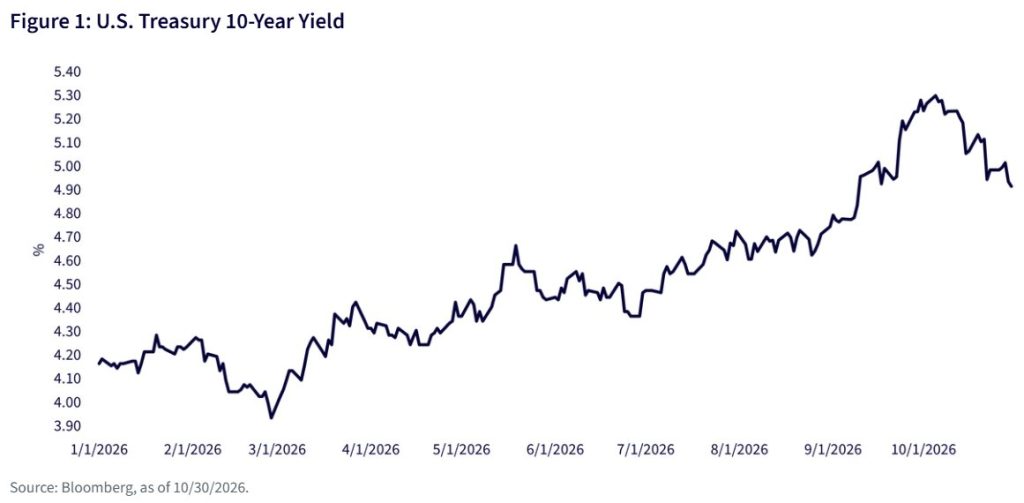
As the above graph reveals, this safe-haven bid was also present before the Middle East war when private credit and business development company (BDC) concerns were dominating the narrative and the UST 10-year yield fell to 3.94%, or 100 basis points below current levels, as of this writing. That is the important aspect to remember for fixed income investors: even with the recent 40-basis-point rally in the 10-year, absolute yield levels are now much higher, with such rallies only producing “higher lows.”
Once things settle down and the safe-haven bid fades, attention will shift back to the four forces we have continued to highlight. So, let’s take a look at where they stand:
- Solid Growth
- Recent data suggest the labor market is fine and steady: the unemployment rate has leveled around 4.2% and weekly jobless claims remain near multi-decade lows below 200,000.
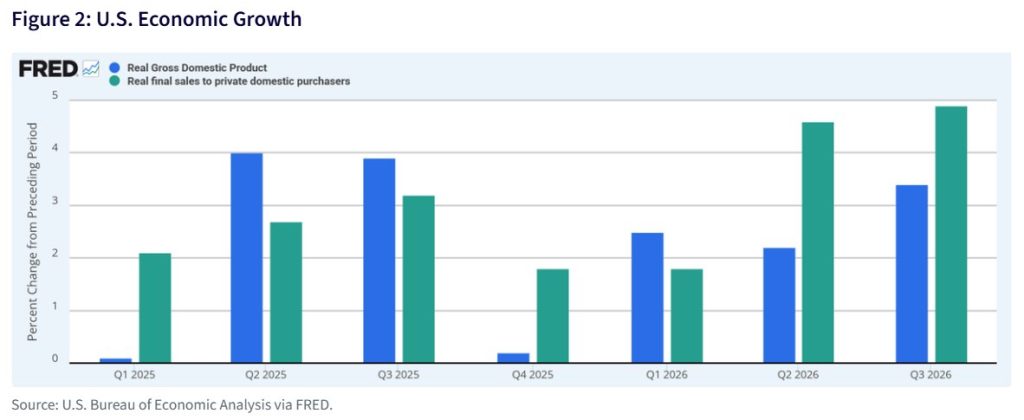
- In the third quarter, real gross domestic product (GDP) grew 3.4% and real final sales to private domestic purchasers accelerated by 4.9%.
- Consumer spending and private investment remain very solid and will give the economy momentum heading into year-end.
- “Sticky,” Above Fed-Target Inflation
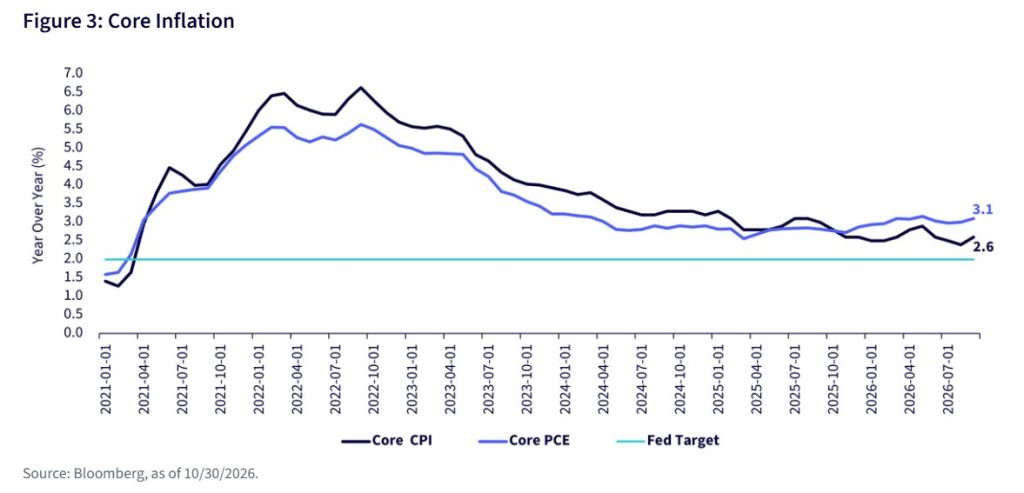
- The September readings for the consumer price index (CPI), producer price index (PPI) and personal consumption expenditures (PCE) all came above the Fed’s target of 2%.
- September core CPI (2.6% year over year) and PPI (6.3% year over year) both came in hotter than expected, while core PCE (3.1% year over year) matched expectations.
- We expect higher energy prices to keep passing through to other areas and the AI buildout to continue applying upward pressure on prices.
- The “Warsh-Uncertainty” Factor
- Removal of forward guidance has created elevated policy uncertainty.
- Adding to this uncertainty will be the change in the 2027 Federal Open Market Committee (FOMC) meeting schedule, where one meeting will not have a vote or policy statement.
- As a result, the bond market wants a higher term premium (higher yield compensation).
- Supply, Supply, Supply
- The U.S. budget deficit rose to just about $2 trillion for fiscal year 2026, and Treasury will need to increase coupon auction sizes going forward.
- Based on recent Treasury forward guidance, any potential increase in coupon auction size could come by mid-2027 and could be concentrated in the 2- to 10-year sector.
- Despite higher long-term rates and recent AI/tech-related setbacks, funding needs for the AI buildout will continue to require more debt issuance.
Conclusion
It seems highly likely that the forces which pushed the UST 10-year yield to a more than 20-year high-water mark are not going away anytime soon. While the “new kid in town” may put a cap on rates in the near term, once the AI/tech-related selloff fades, the old-school factors should still have a visible impact on the UST 10-year yield moving forward.
Originally published on November 5, 2026 on WisdomTree blog
PHOTO CREDIT: https://www.shutterstock.com/g/Panteleev+Aleksey
VIA SHUTTERSTOCK
DISCLOSURES
Investors should carefully consider the investment objectives, risks, charges and expenses of the Funds before investing. U.S. investors only: To obtain a prospectus containing this and other important information, please call 866.909.9473, or click here to view or download a prospectus online. Read the prospectus carefully before you invest. There are risks involved with investing, including the possible loss of principal. Past performance does not guarantee future results.
You cannot invest directly in an index.
Foreign investing involves currency, political and economic risk. Funds focusing on a single country, sector and/or funds that emphasize investments in smaller companies may experience greater price volatility. Investments in emerging markets, real estate, currency, fixed income and alternative investments include additional risks. Due to the investment strategy of certain Funds, they may make higher capital gain distributions than other ETFs. Please see prospectus for discussion of risks.
WisdomTree Funds are distributed by Foreside Fund Services, LLC, in the U.S.