By:
Christine Norton, CFA, Investment Strategist
Chris Carpentier, CFA, FRM, Senior Investment Strategist
The midterms added political and regulatory uncertainty to the AI outlook. That may fuel near-term volatility, but we do not believe it fundamentally changes the long-term investment case for AI.
US equities came under sharp pressure on Thursday as investors digested the implications of the midterm elections. While a Democratic sweep had become increasingly anticipated heading into Election Day, the breadth of the results brought the sector-specific implications of the new political landscape into sharper focus, particularly for the AI infrastructure buildout.
The Nasdaq Composite fell 5.5%, compared with a 4.4% decline for the S&P 500, while many semiconductor and data-center-related stocks experienced substantially larger losses.1
While the election was not the sole cause of the AI correction, it added political and regulatory uncertainty that accelerated a repricing already underway.
AI correction predates the election
The midterm results intensified pressures that had already been building within the AI complex. The scale and financing of AI capital spending, elevated earnings expectations, and questions around monetization had raised the hurdle for further gains. Against that backdrop, investors had become less forgiving of challenges to the AI growth story.
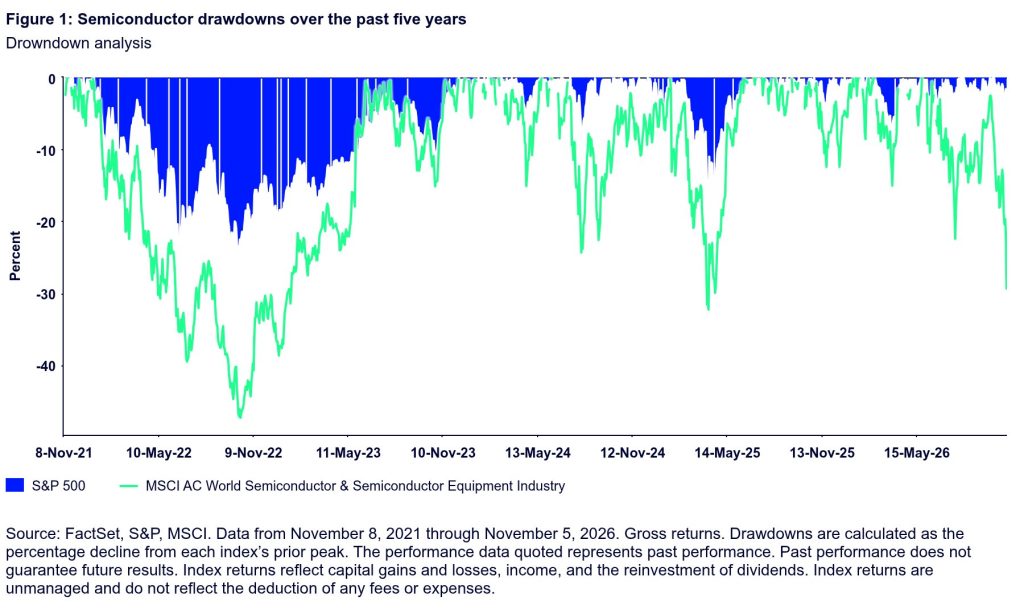
Global semiconductors were already in a 20% drawdown before the midterm elections, while broad US equities had held up comparatively well. That suggests the correction began as a concentrated repricing of AI-related stocks, rather than reflecting a market-wide deterioration in US equities. Thursday’s selloff extended beyond the AI trade, but semiconductor and other AI-related stocks continued to experience the steepest declines.
Such downturns are not unprecedented. Semiconductor equities have experienced multiple meaningful corrections over the past five years, including considerably deeper drawdowns in 2022 and 2025 (Figure 1).
Midterms add a new source of friction
The election has nevertheless added another layer of uncertainty, bringing concerns around power demand, infrastructure, and the impact of data centers on local communities into sharper focus. Democratic gains, particularly in key state races, could increase scrutiny of AI providers and data-center development, creating additional friction around where and how quickly new capacity is built.
But we believe the market reaction overstates how much the election changes the longer-term trajectory of AI development. At the federal level, Democratic control of Congress alone would not likely be enough to curtail the buildout in the face of a presidential veto. AI remains a strategic priority for both parties.
The election may add to near-term volatility, but it’s unlikely to change the long-term AI investment case.
No reset of the AI thesis
Volatility may remain elevated as investors assess the regulatory risks facing AI and data-center development under the new political landscape. But periods of repricing can also help reset expectations after strong gains and create opportunities for longer-term investors. We remain constructive on US equities, with an emphasis on selectivity.
This environment also reinforces the importance of looking beyond the most crowded parts of the AI trade. As the investment cycle matures, the focus may shift beyond AI enablers to adopters positioned to benefit from deploying the technology.
For investors, that means looking across the AI value chain, with an emphasis on businesses positioned to translate structural demand into sustainable earnings and returns on capital.
Originally posted on November 6, 2026 on SSGA blog
PHOTO CREDIT: https://www.shutterstock.com/g/iLixe48
VIA SHUTTERSTOCK
FOOTNOTES AND SOURCES
1 FactSet, as of November 6, 2026.
DISCLOSURES
Marketing Communication
statestreet.com/im
State Street Global Advisors Worldwide Entities
State Street Global Advisors (SSGA) is now State Street Investment Management. Please go to statestreet.com/investment-management for more information.
Investing involves risk including the risk of loss of principal.
The information provided does not constitute investment advice and should not be relied on as such. It should not be considered a solicitation to buy or an offer to sell a security. It does not take into account any investor’s particular investment objectives, strategies, tax status or investment horizon. You should consult your tax and financial advisor.
The information contained in this communication is not a research recommendation or “investment research” and is classified as a “Marketing Communication” in accordance with applicable regional regulation. This means that this marketing communication: (a) has not been prepared in accordance with legal requirements designed to promote the independence of investment research; and (b) is not subject to any prohibition on dealing ahead of the dissemination of investment research.
The views expressed in this material are the views of Christine Norton and Chris Carpentier through the period ended 06 November 2026 and are subject to change based on market and other conditions. This document contains certain statements that may be deemed forward-looking statements. Please note that any such statements are not guarantees of future performance, and actual results or developments may differ materially from those projected.
The performance data quoted represents past performance. Past performance does not guarantee future results.
Index returns are unmanaged and do not reflect the deduction of any fees or expenses. Index returns reflect all items of income, gain and loss and the reinvestment of dividends and other income, as applicable.
All index performance results referred to are provided exclusively for comparison purposes only. It should not be assumed that they represent the performance of any particular investment.
Because of their narrow focus, sector investments tend to be more volatile than investments that diversify across many sectors and companies. Narrowly focused investments and investments in technology stocks may involve greater risk of capital loss and higher price volatility.
All information is from State Street Investment Management unless otherwise noted and has been obtained from sources believed to be reliable, but its accuracy is not guaranteed. There is no representation or warranty as to the current accuracy, reliability or completeness of, nor liability for, decisions based on such information, and it should not be relied on as such.
The whole or any part of this work may not be reproduced, copied or transmitted, or any of its contents disclosed to third parties, without State Street Investment Management’s express written consent.
The trademarks and service marks referenced herein are the property of their respective owners. Third-party data providers make no warranties or representations of any kind relating to the accuracy, completeness or timeliness of the data and have no liability for damages of any kind relating to the use of such data.