By:
Simona M Mocuta, Chief Economist
Amy Le, CFA, Investment Strategist
Krishna Bhimavarapu, Economist
A hawkish Warsh speech lifts Fed hike odds, Canada records broad second-quarter gains, and Australia’s July inflation data strengthens expectations for another rate hike as September comes into view.
US: Looks like we have work to do
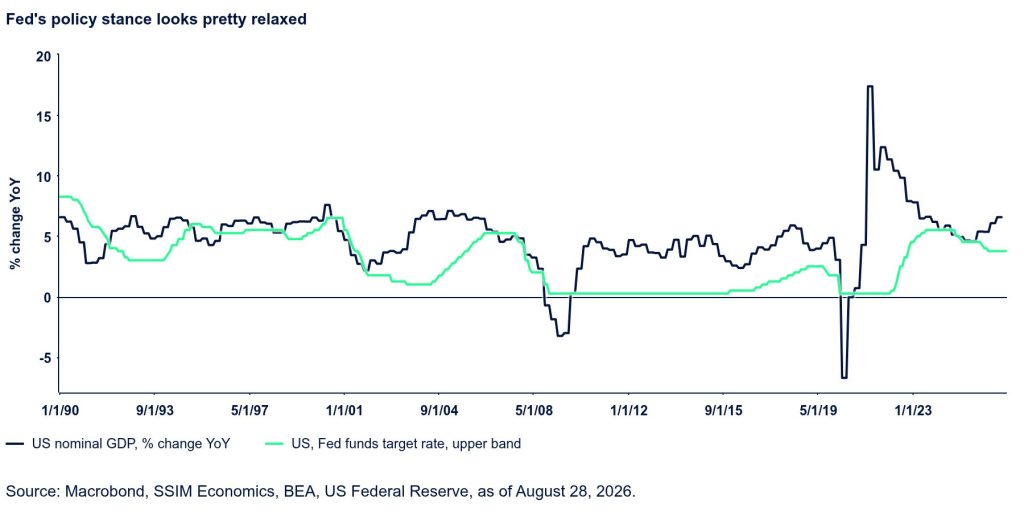
There might not have been many “tier 1” macro data releases this week, but there was a top-tier event: the Fed’s Jackson Hole symposium. It was Chair Warsh’s first opportunity to deliver longer-form remarks since taking the helm at the Fed, and he embraced a clear hawkish tilt.
There were several layers to his hawkishness. He reiterated in very clear terms that “the Fed’s price-stability objective of 2 percent, as measured by the PCE index, is a firm, fixed target.” This should not be news to anyone, but it was still important for him to say it. In more practical terms, he stated that “we must be confident that underlying inflation is moving to our objective, clearly and at sufficient speed… otherwise, we have work to do.” This is perhaps the closest he came to providing forward guidance, the reason being that it seems unlikely that those conditions will be met convincingly in the very near term. The conclusion, then, is that the Fed still has “work to do.” Additionally, he downplayed the more encouraging signals, such as tame wage inflation and anchored inflation expectations. He also seemed to dismiss pressures in specific sectors such as housing and emphasized instead the overall economy’s resilient, impressive performance. He would be “hard-pressed” to describe financial conditions as restrictive.
The partial counterweight to this hawkishness was the clear humility he invoked repeatedly in respect to interpreting and responding to the complex, living entity that is the US economy. Questions around data quality and timeliness, the emphasis on trends, the refusals to describe a reaction function, and the acknowledged unknowns around all the big-picture questions surrounding AI softened the otherwise hawkish messaging somewhat.
Nevertheless, the implication is clear: the bias is toward higher rates. Incoming data will need to offer more convincing evidence of improving inflation trends (or labor market deterioration) in order to allow the Fed to remain on hold. The burden of proof is on the doves. We still believe the doves prevail in September (aided by data), but it’s a very close call!
Canada: Volatile improvement
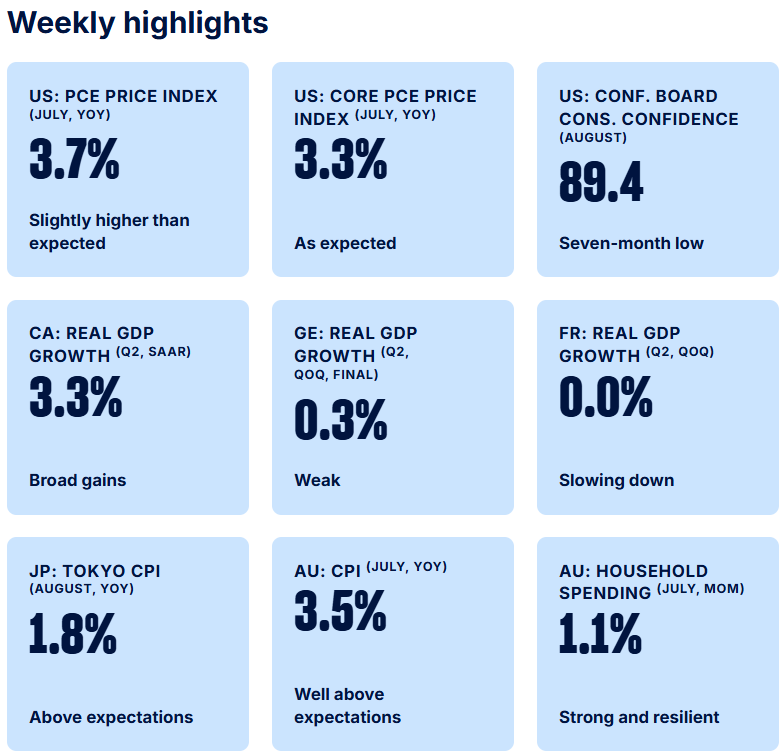
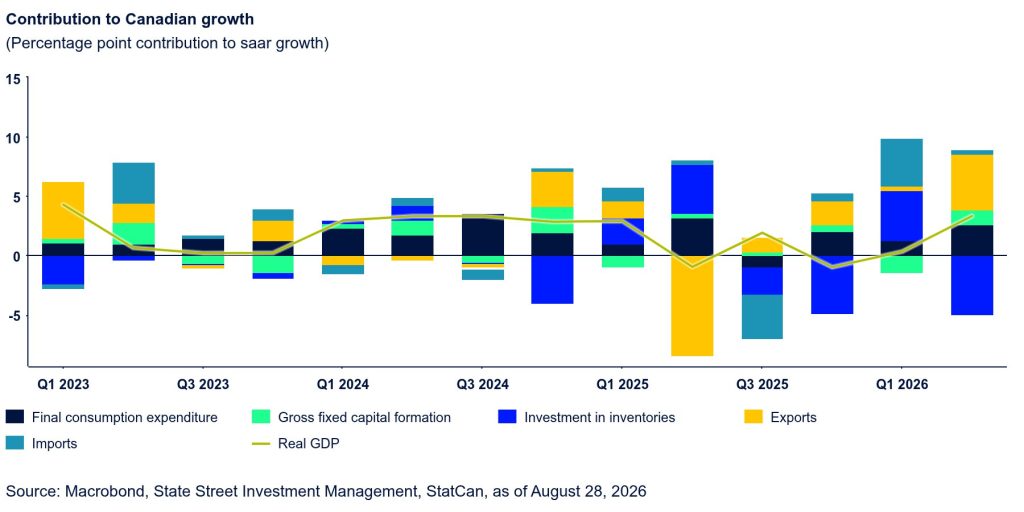
The economy delivered on expectations of strong growth in the second quarter, with real GDP expanding at a 3.3% seasonally adjusted annualized rate (saar), the best showing in almost two years. As has been the case recently, trade and inventories made outsized, almost offsetting contributions to growth, reflecting the timing of capturing goods flowing through the economy at a time when foreign trade shifts massively in response to trade policy changes.
The best news is that both consumption and fixed investment made stronger contributions to growth during the second quarter. Consumer spending grew 0.8% QoQ, the most in a year, driven primarily by spending on services. The World Cup helped here. After a very disappointing contraction during the first quarter, fixed investment rebounded (though not fully) in the second. But performance here remains weak overall, with real fixed investment growing by just 0.4% YoY on average during the past three quarters. Notably, investment in intellectual property products contracted outright during the second quarter.
Exports added 4.8 percentage points to saar quarterly growth, offset by a 4.9 ppt detraction from inventories. Directionally, this mirrors developments in the second quarter of 2025, when tariffs first meaningfully impacted trade flows. Chunky, volatile moves in the trade and inventories components are likely to persist amid ongoing trade tensions and the latest tariff escalation between Canada and the US.
Australia: Beats across the board
July CPI exceeded expectations sequentially and annually, across both the headline and trimmed mean measures. The outcome reinforces the view that inflation is proving stickier than expected, including our own forecasts. While July is often subject to significant seasonality due to annual price revisions and school holiday-related distortions, last year’s July data also played a key role in shaping the Reserve Bank of Australia’s (RBA) hawkish reaction function. We did expect some of that seasonality to have been adjusted this round, but there is a good chance this year’s spending generally was stronger. It is worth noting that Australia’s monthly CPI series remains relatively new, meaning seasonal adjustment factors may continue to evolve as more observations become available.
For now, however, the data has strengthened market expectations of another rate hike this year, a view we have maintained for some time and one that could ultimately see the unemployment rate rise toward our peak forecast of 4.8%.
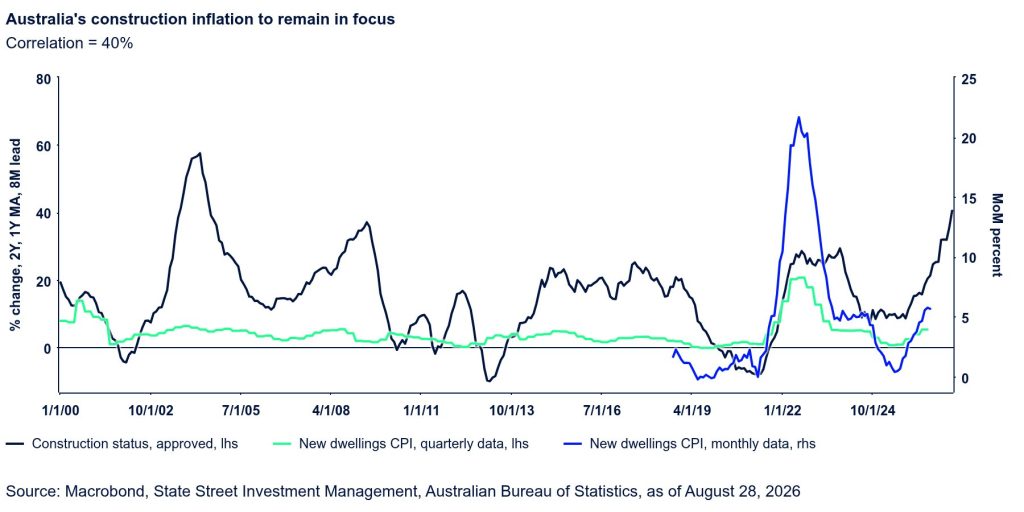
Compositionally, the upside surprise was driven by a sharp increase in fuel prices, alongside seasonal gains in domestic holiday travel associated with the winter school holiday period. Yet housing inflation remains the more important medium-term story. New dwelling inflation accelerated by 0.4% MoM, while rents also rose 0.4%, extending a trend that has become increasingly difficult to ignore.
At first glance, the persistence of construction-related inflation may appear surprising given the moderation in dwelling approvals highlighted in our recent work. However, approvals have slowed in an orderly manner rather than collapsed, leaving overall construction activity elevated. The pipeline of approved projects remains large enough to sustain demand for labor, materials and construction services. Our analysis suggests construction activity continues to lead new dwelling purchase inflation with a meaningful lag (Figure 3), implying housing-related CPI pressures may remain sticky even as the housing approvals cycle cools.
Attention now shifts to next week’s Q2 GDP release, which will provide a broader assessment of how the economy is navigating the cumulative effects of past policy tightening. We expect growth to remain subdued by historical standards, but somewhat firmer than market expectations, forecasting 0.3% QoQ versus the consensus estimate of 0.2%. Household consumption is likely to have remained resilient, supported by lower savings and a relatively stable labor market. While partial indicators suggest some slowing in areas that have supported growth in recent quarters, we suspect overall activity has remained more resilient.
Taken together, the latest inflation data and our GDP expectations point to an economy that is driving in the slow lane, but not slowing fast enough to generate broad-based disinflation. Should GDP surprise to the upside next week, the case for another RBA hike this year would strengthen further. In that scenario, both the August labor market and CPI releases would likely need to materially underwhelm for markets to meaningfully downshift away from another hike. For now, we continue to see September as a good candidate for the next hike.
Originally posted on August 31, 2026 on State Street Investment Management blog
PHOTO CREDIT: https://www.shutterstock.com/g/Rawpixel
EDITED VIA SHUTTERSTOCK
DISCLOSURES
www.statestreet.com/im
Marketing Communication
Important Risk Information
Investing involves risk including the risk of loss of principal.
All information is from SSIM unless otherwise noted and has been obtained from sources believed to be reliable, but its accuracy is not guaranteed. There is no representation or warranty as to the current accuracy, reliability, or completeness of, nor liability for, decisions based on such information, and it should not be relied on as such.
The information provided does not constitute investment advice and it should not be relied on as such. It should not be considered a solicitation to buy or an offer to sell a security. It does not take into account any investor’s particular investment objectives, strategies, tax status or investment horizon. You should consult your tax and financial advisor.
The trademarks and service marks referenced herein are the property of their respective owners. Third party data providers make no warranties or representations of any kind relating to the accuracy, completeness or timeliness of the data and have no liability for damages of any kind relating to the use of such data.
The whole or any part of this work may not be reproduced, copied, or transmitted or any of its contents disclosed to third parties without SSIM’s express written consent.
The views expressed in this material are the views of SSIM Economics Team through the period ended August 28, 2026, and are subject to change based on market and other conditions.
This document may contain certain statements deemed to be forward-looking statements. All statements, other than historical facts, contained within this document that address activities, events or developments that SSIM expects, believes or anticipates will or may occur in the future are forward-looking statements. These statements are based on certain assumptions and analyses made by SSIM in light of its experience and perception of historical trends, current conditions, expected future developments and other factors it believes are appropriate in the circumstances, many of which are detailed herein. Such statements are subject to a number of assumptions, risks, uncertainties, many of which are beyond SSIM’s control. Please note that any such statements are not guarantees of any future performance and that actual results or developments may differ materially from those projected in the forward-looking statements.
The information contained in this communication is not a research recommendation or ‘investment research’ and is classified as a ‘Marketing Communication’ in accordance with the Markets in Financial Instruments Directive (2014/65/EU) or applicable Swiss regulation. This means that this marketing communication (a) has not been prepared in accordance with legal requirements designed to promote the independence of investment research (b) is not subject to any prohibition on dealing ahead of the dissemination of investment research.
Intellectual Property Information
BLOOMBERG®, a trademark and service mark of Bloomberg Finance L.P. Standard & Poor’s S&P 500 Index® is a registered trademark of Standard & Poor’s Financial Services LLC. FTSE 100® is a trademark jointly owned by the London Stock Exchange Plc and The Financial Times Limited, and is used by FTSE International Limited under license. “All-World”, “All-Share” and “All-Small” are trademarks of FTSE International Limited.