By: Altaf Kassam, CFA, Europe Head of Investment Strategy & Research
Markets are no longer underwriting AI on promise alone. Investors now want evidence that rising AI spend delivers margins, productivity, and cash flow. As enthusiasm matures, selectivity returns—and execution becomes the differentiator.
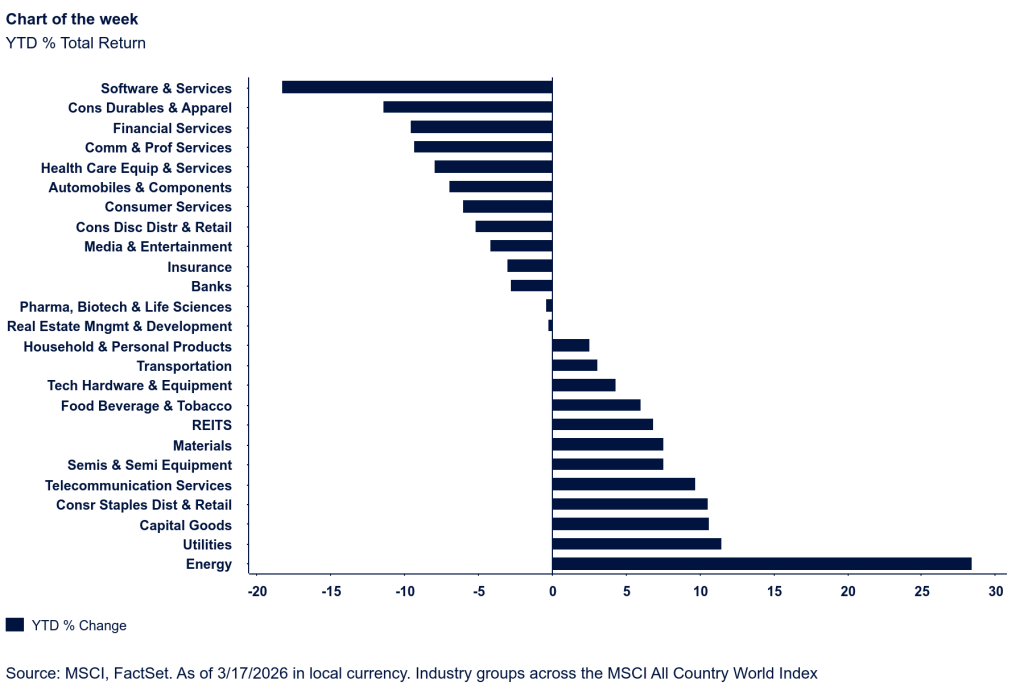
AI disruption has been a driving theme to start the year. Software & Services leads declines (-18%), with broader service industries also lagging as investors price in AI-driven disruption to labor-intensive business models. At the other extreme, Energy, Utilities, and Capital Goods lead performance—capital-intensive, asset-heavy, “old economy” sectors are benefiting from tangible assets, pricing power, and relative insulation from near-term AI displacement.
AI isn’t broken—but the market needs to see the impact
For the better part of two years, markets have treated artificial intelligence as a one‑way bet. If a company spent heavily on AI infrastructure, investors were willing to trust that the payoff would arrive in due course. That era is ending. AI is not falling apart—but the market is done underwriting it on faith alone.
The shift has been subtle but decisive. We have moved from a “build it and they will come” mentality to something closer to a “show me the money” regime. Investors increasingly want to see that large-scale AI investment is generating real financial results, or at least a credible path to them. Last quarter offered a glimpse of what this new reality looks like. Two companies, both announcing surging AI‑related capex, received sharply different market reactions: one showed clear evidence that AI was already lifting margins; the other struggled to demonstrate the link. The market now treats those differences seriously.
This is not skepticism for skepticism’s sake. It is a sign that AI is maturing. In every major technological cycle, investors eventually shift from rewarding ambition to rewarding execution. That transition is healthy. It forces capital to flow to companies that can translate engineering breakthroughs into genuine productivity and genuine cash flow—not just marketing slides.
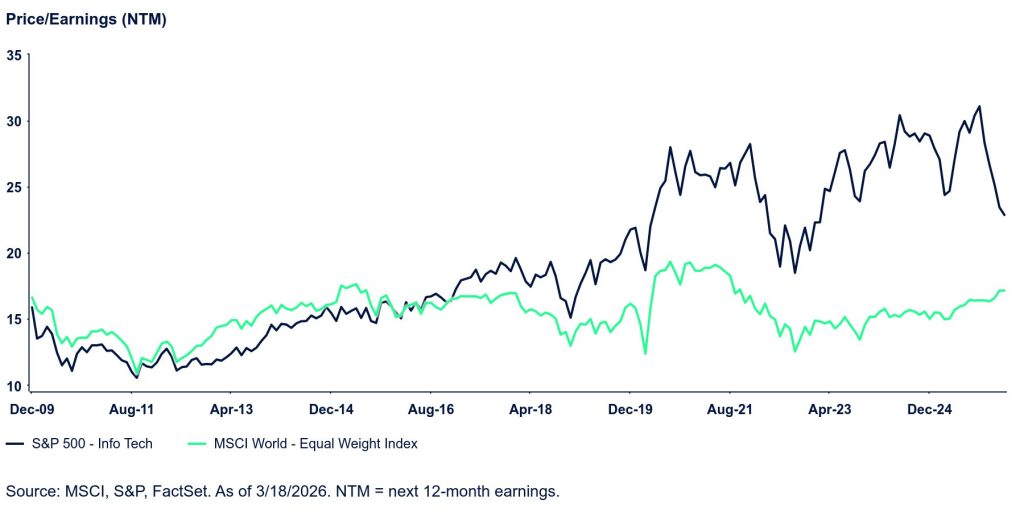
Part of the reason investors have become more selective is simple arithmetic. The idea that valuations in US large-cap technology have “normalized” is wishful thinking. Even after a wobble, many AI winners still trade at stretched multiples relative to their own history—and to European and smaller‑cap peers. That does not make them uninvestable; it simply means the hurdle for incremental belief is higher. In this environment, selectivity is not an intellectual preference—it is a pricing necessity.
The market itself is enforcing that discipline. Capital is now flowing toward firms that can articulate—with evidence—how AI improves targeting, reduces costs, or boosts revenue per user. The rest are discovering that “AI exposure” is no longer enough to guarantee a premium multiple.
Capex: A surge, not a new normal
One point often lost in the noise: rising AI capex does not imply that global capital intensity is entering a new, permanently higher regime. Much of today’s spending is front‑loaded—the cost of building the computational backbone for the next decade. Once capacity and power constraints ease, growth in capex should slow, even if absolute levels remain high. For investors, this distinction matters. A world of ever‑rising capital intensity erodes free cash flow; a world of front‑loaded investment sets the stage for operating leverage later.
Labor will shift—but not collapse
The debate over AI and labor is increasingly polemical, but the most dramatic scenarios—mass, rapid displacement across knowledge industries—look implausible. Labor markets do not adjust that way. Regulation, institutional norms, and sectoral frictions slow the process. What we are far more likely to see is labor rotation: tasks shifting between roles, new job categories emerging, and younger workers absorbing the brunt of the transition. That is disruptive, but it is not dystopian.
Productivity is real—but not unbounded
AI is already lifting productivity in ways that are visible in corporate reporting. But expectations of exponential productivity growth run up against physical limits. Chips, energy, and data centers are not abstract constraints; they are binding ones. The pace of AI‑enabled productivity gains will depend as much on power grids and semiconductor supply as on advances in model architecture.
Not everything will mean‑revert
One area where investors may need to temper their optimism is the assumption that recent spikes in energy, gold, and defensives will unwind cleanly once geopolitical tensions fade. Even if spot prices settle, the risk premia behind them may not. Energy volatility now looks more structural than cyclical. Gold, too, has strengthened its case as a strategic asset. And in equities, defensives with AI‑adjacency—such as utilities and healthcare—appear far more resilient than staples, which look most exposed to reversal.
The memory of supply shocks tends to linger. Markets carry scars. One consequence is a higher-forlonger equity–bond correlation—a regime we may be living with for some time.
Inflation fear still rules policy
Even without a fresh inflation shock, the fear of inflation is enough to limit central banks’ willingness to cut aggressively. That matters. It suggests any industrial revival—tentative though it is—may struggle to gain traction without the customary support of accommodative policy. Rate relief will come, but not at the pace markets once hoped.
A more skeptical, more rational market
None of this means AI enthusiasm is misguided. The technology is transformative. However, we are now entering the phase where investors insist on evidence, not aspiration. That will make markets bumpier, but ultimately healthier. AI is not broken. It is simply being repriced—from a story to a strategy, from a theme to a testable proposition.
Originally posted on March 19, 2026 on SSGA blog
PHOTO CREDIT: https://www.shutterstock.com/g/micic
VIA SHUTTERSTOCK
DISCLOSURES:
Marketing Communication
State Street Global Advisors Worldwide Entities
State Street Global Advisors (SSGA) is now State Street Investment Management. Please go to statestreet.com/investment-management for more information.
The information provided does not constitute investment advice and it should not be relied on as such. It should not be considered a solicitation to buy or an offer to sell a security. It does not take into account any investor’s particular investment objectives, strategies, tax status or investment horizon. You should consult your tax and financial advisor.
The information contained in this communication is not a research recommendation or ‘investment research’ and is classified as a ‘Marketing Communication’ in accordance with the applicable regional regulation. This means that this marketing communication (a) has not been prepared in accordance with legal requirements designed to promote the independence of investment research (b) is not subject to any prohibition on dealing ahead of the dissemination of investment research.
This communication is directed at professional clients (this includes eligible counterparties as defined by the “appropriate EU regulator”) who are deemed both knowledgeable and experienced in matters relating to investments. The products and services to which this communication relates are only available to such persons and persons of any other description (including retail clients) should not rely on this communication.
The views expressed in this material are the views of Altaf Kassam, through the period ended March 19, 2026 and are subject to change based on market and other conditions. and are subject to change based on market and other conditions. This document contains certain statements that may be deemed forward-looking statements. Please note that any such statements are not guarantees of any future performance and actual results or developments may differ materially from those projected. Investing involves risk including the risk of loss of principal.
Investing involves risk including the risk of loss of principal.
Past performance is not a reliable indicator of future performance.
The whole or any part of this work may not be reproduced, copied or transmitted or any of its contents disclosed to third parties without SSGA’s express written consent.
All information is from SSGA unless otherwise noted and has been obtained from sources believed to be reliable, but its accuracy is not guaranteed. There is no representation or warranty as to the current accuracy, reliability or completeness of, nor liability for, decisions based on such information and it should not be relied on as such.
Equity securities may fluctuate in value and can decline significantly in response to the activities of individual companies and general market and economic conditions.
Index returns are unmanaged and do not reflect the deduction of any fees or expenses. Index returns reflect all items of income, gain and loss and the reinvestment of dividends and other income as applicable.
Diversification does not ensure a profit or guarantee against loss. It is not possible to invest directly in an index. Index performance does not reflect charges and expenses associated with the fund or brokerage commissions associated with buying and selling a fund. Index performance is not meant to represent that of any particular fund.
Bonds generally present less short-term risk and volatility than stocks, but contain interest rate risk (as interest rates raise, bond prices usually fall); issuer default risk; issuer credit risk; liquidity risk; and inflation risk. These effects are usually pronounced for longer-term securities. Any fixed income security sold or redeemed prior to maturity may be subject to a substantial gain or loss.
Currency Risk is a form of risk that arises from the change in price of one currency against another. Whenever investors or companies have assets or business operations across national borders, they face currency risk if their positions are not hedged.
Asset Allocation is a method of diversification which positions assets among major investment categories. Asset Allocation may be used in an effort to manage risk and enhance returns. It does not, however, guarantee a profit or protect against loss.
Increase in real interest rates can cause the price of inflation-protected debt securities to decrease. Interest payments on inflation-protected debt securities can be unpredictable.
There are risks associated with investing in Real Assets and the Real Assets sector, including real estate, precious metals and natural resources. Investments can be significantly affected by events relating to these industries.
Investing in foreign domiciled securities may involve risk of capital loss from unfavorable fluctuation in currency values, withholding taxes, from differences in generally accepted accounting principles or from economic or political instability in other nations. Investments in emerging or developing markets may be more volatile and less liquid than investing in developed markets and may involve exposure to economic structures that are generally less diverse and mature and to political systems which have less stability than those of more developed countries.
Generally, among asset classes, stocks are more volatile than bonds or short-term instruments. Government bonds and corporate bonds generally have more moderate short-term price fluctuations than stocks, but provide lower potential long-term returns. U.S. Treasury Bills maintain a stable value if held to maturity, but returns are generally only slightly above the inflation rate.