By: Sreeni Meka
Growing national debt
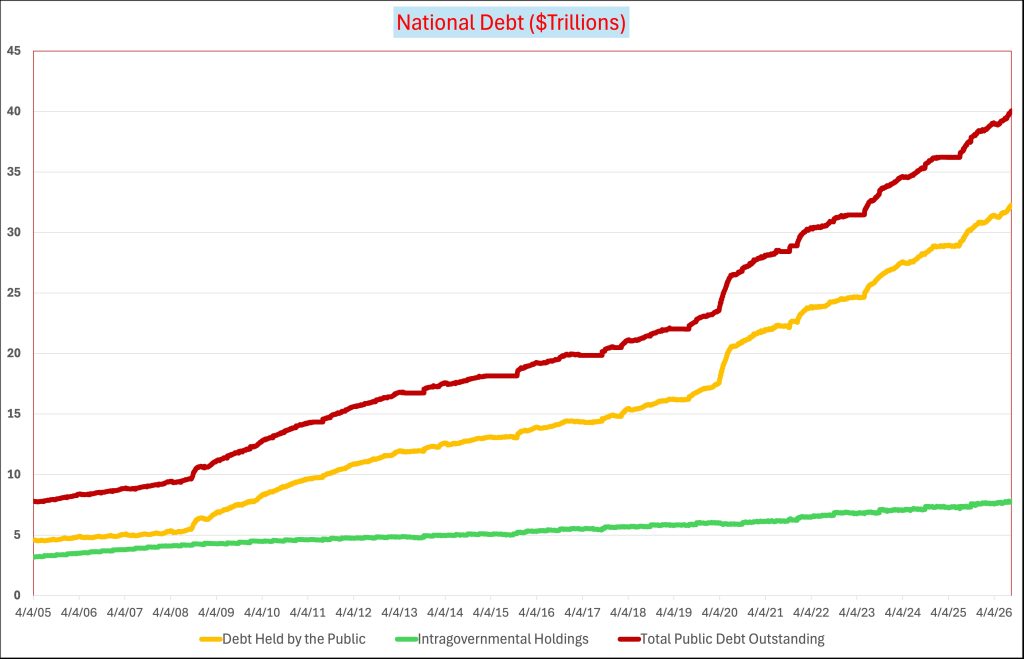
It is human nature; we all pay attention to round numbers. Recently, our national debt passed the $40 trillion mark, which is $90,000 per head. Of the $40 trillion in debt, $7.78 trillion, or 19.4%, is intergovernmental, and the public holds the remaining 80.6%. Our average interest on the debt is about 3.32%, and most of it is domestically owned. Foreign nations and entities like Japan, the UK, and China hold approximately $9.3 trillion, or 23 percent of the total debt. In fiscal year 2026, federal government spending exceeded $1.8 trillion, adding to the ever-growing national debt. Fiscal expansion, which is spending more than receipts, increases overall debt and is inherently inflationary.
In the second quarter of 2008, U.S. federal debt held by the public totaled about $5.3 trillion, or 35% of gross domestic product (GDP). This figure grew to $40 trillion, and the debt-to-GDP ratio grew to 123%. In layman’s terms, national debt increased by 7.5 times while our GDP grew 1.6 times.
Most of us tend to look at debt through our own personal experience. At the household level, we know that excessive borrowing and persistent deficit spending cannot continue forever. Eventually, the debt must be repaid, reduced, or renegotiated if the borrower cannot meet the obligation. So naturally, we tend to apply the same logic to governments. But governments are not households, and that comparison can be misleading. The economics of government debt are quite different for several important reasons.
Debt refinance
Unlike households, governments do not have a finite lifespan and therefore do not have to eliminate their debt over a fixed period. When Treasury debt matures, the government can issue new debt to repay the old debt, effectively rolling it over indefinitely. As the economy and GDP grow, debt can also grow without necessarily creating a problem, as long as the government’s ability to service that debt grows along with it. U.S. government debt is primarily issued through Treasury securities, which are highly liquid and widely used by investors, corporations, banks, and financial institutions almost like cash.
Another important difference is that U.S. Treasury debt is denominated in dollars, and the federal government ultimately controls the supply of dollars. This makes Treasury securities fundamentally different from household or corporate debt. The government can always make dollar-denominated interest and principal payments unless it chooses not to. Therefore, the larger risk is not a traditional inability to repay, but the economic consequences of excessive borrowing—higher inflation, higher interest costs, pressure on interest rates, or eventually a loss of confidence in the dollar. This is why the real question is not simply, “How will the government pay back the national debt?” but rather, “How much debt can the economy comfortably support?”
Treasury debt as currency
To the extent the national debt is held by domestic investors, it also represents private-sector wealth. During weak economic periods, deficit-financed tax cuts or government transfers can increase that wealth and stimulate spending, while the same policies near full employment may mainly create inflation and redistribute purchasing power. In that sense, Treasury securities can be viewed not just as government debt, but also as a highly liquid, safe form of financial wealth circulating through the economy. The real concern, therefore, is not simply whether the national debt must be “paid back,” but whether continued debt creation eventually creates inflation, higher interest costs, or loss of confidence.
Cost of carrying debt
Treasury securities may not need to be permanently paid off, but they still have to be serviced through interest payments. This interest expense is the government’s cost of carrying debt. Unlike corporations, however, the federal government faces much less refinancing risk because it issues debt in its own currency and the Federal Reserve can support financial markets when necessary. Treasury debt is also considered one of the safest and most liquid assets in the world, allowing the government to borrow at relatively low interest rates.
The more important question is whether the economy grows faster than the cost of servicing that debt. If government borrowing supports productive investments such as infrastructure, healthcare, education, or other programs that improve economic growth, the benefits can exceed the borrowing cost. Even without directly measurable returns, if the average interest rate on government debt remains below the economy’s nominal growth rate, the debt burden relative to GDP can remain manageable even as the government continues to run moderate primary deficits.
The Federal Reserve and government debt
The government’s average interest cost depends partly on the mix of currency, bank reserves, Treasury bills, notes, and bonds. When the Federal Reserve buys Treasury securities, it effectively replaces Treasury debt with bank reserves. Today, however, those reserves pay interest, so this form of “debt monetization” differs from the past, when much of the Fed’s liabilities consisted of zero-interest currency. As a result, shifting debt onto the Fed’s balance sheet does not necessarily eliminate the government’s interest cost.
More important is the debt-to-GDP ratio, which depends not only on how much debt the government issues but also on economic growth, inflation, interest rates, and investor demand for Treasuries. Higher debt increases the numerator, but stronger nominal GDP growth can offset some of that increase. There is clearly some limit to how much government debt markets will absorb at acceptable interest rates and inflation levels. Still, no one knows exactly where that limit is until markets begin to push back.
The national debt itself is not the immediate problem; the real issue is whether the economy can grow fast enough to support it. As long as growth keeps pace with the cost of carrying the debt, it can remain manageable. The concern begins when debt and interest costs consistently grow faster than the economy, creating inflationary pressure, higher taxes, or less flexibility for future government spending.
Originally posted on August 19, 2026 by Lakeland Wealth Management LLC
PHOTO CREDIT: https://www.shutterstock.com/g/tete_escape
DISCLOSURES
Investing involves risk, including the possible loss of principal. Diversification does not ensure a profit nor guarantee against a loss.
Lakeland Wealth Management LLC is a registered investment adviser. Lakeland Wealth Management LLC provides data to Interactive Advisors pursuant to a licensing agreement. Lake Wealth Management LLC does not provide investment advice to Interactive Advisors or Interactive Advisors clients.
This material represents an assessment of the market environment at a specific point in time and is not intended to be a forecast of future events, or a guarantee of future results. This information is not intended to be individual or personalized investment or tax advice and should not be used for trading purposes. Please consult a financial advisor or tax professional for more information regarding your investment and/or tax situation.