By: Jose Torres, Senior Economist, Interactive Brokers
A blockbuster beat on nonfarm payrolls this morning is helping stocks pare a modest amount of yesterday’s historic tech losses by strengthening confidence that the economic expansion is thriving. Positive comments in support of AI from President Trump and newly-elected Democratic leaders as well as news that the commander in chief spoke with Qatar in an effort to quell geopolitical hostilities with Iran are reducing jitters and currently underpinning markets, but only at the margins, as rising short-term interest rates stemming from better-than-expected hiring and consumer sentiment is capping gains for the cyclicals, which has the Dow Jones Industrial Average dropping slightly while the other three major equity benchmarks climb north of 1%. Sinking oil prices are limiting an increase in long-end yields though, as softening inflation expectations offset the impact of robust growth, however, the closer tenors on the curve are jumping in light of higher Fed hike probabilities following the headline buoyancy, a drop in unemployment and accelerating wage pressures. Still, fixed-income watchers see approximately just 2 more 25-bp increases on the horizon through next year. Meanwhile, despite 9 of the 11 principal sectors participating in the rebound, volatility levels remain elevated and investors seem anxious, which explains today’s sluggish, dead-cat bounce. Elsewhere on the trading floor, the greenback is appreciating, commodities are broadly lower and cryptocurrencies are near their flatlines.
Payroll Growth Picks Up, Exceeding Expectations
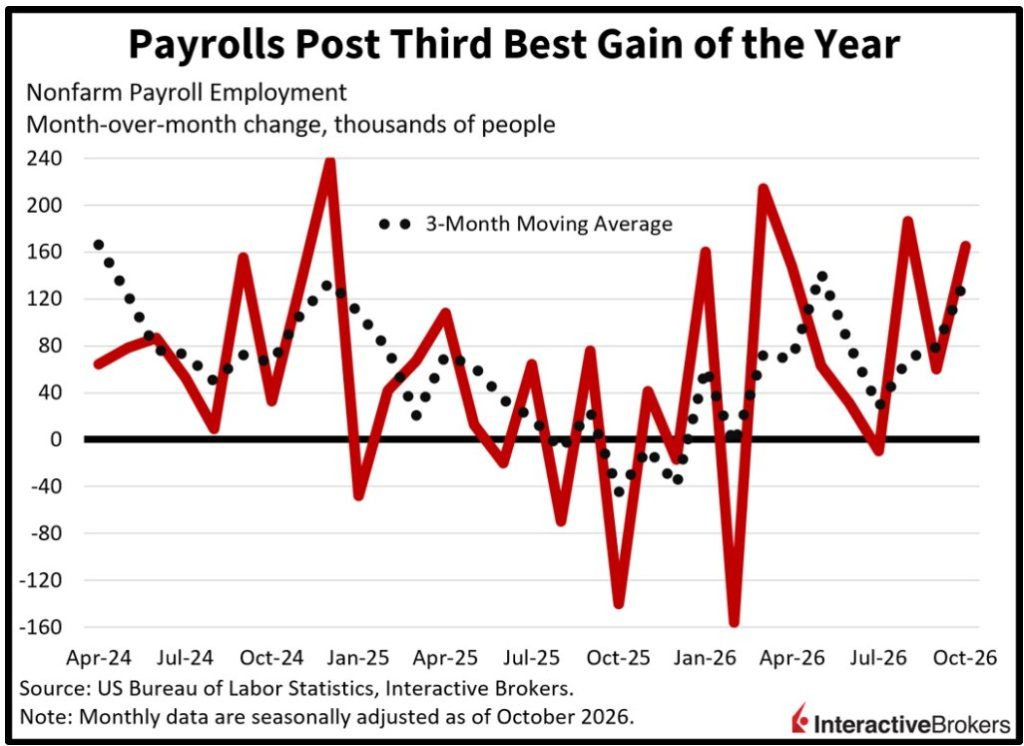
Hiring accelerated briskly last month as the1 165k headline beat surpassed every economist forecast. The result exceeded the 65k median estimate and September’s upwardly revised 60k. August was also adjusted higher, which together with accelerating wage pressures and sinking unemployment provided evidence of a robust labor market. Indeed, average hourly earnings climbed 0.4% month over month (m/m) and 3.1% year over year (y/y), ahead of the 0.3% and 2.9% anticipated and near the prior period’s 0.3% and 3.2%. Joblessness fell to 4.1% while projections were looking for an unchanged 4.2%, and the participation rate rose 10 basis points (bps) to 61.9%. The professional/business services, private education/health services, transportation/warehousing and manufacturing sectors led the roster increases with lifts of 70k, 53k, 25k and 19k. Retail trade, utilities, financial activities, government and other services grew more modestly at 7k or under. Conversely, leisure/hospitality, wholesale trade, construction and mining reduced headcounts by 13k or less.
Consumer Sentiment Improves
Consumer sentiment improved this month as rising optimism about the road ahead offset anxieties related to the possibility of an AI bubble and the volatility it’s introduced to individual portfolios. The University of Michigan’s headline number of 51 increased from October’s 46.3 and arrived north of the forecast standing at 48. Similarly, the sub-indices tied to current and future conditions rose from 44.7 and 47.3 to 51 and 50.9, as a decline in 1- and 5-year inflation expectations from 4.7% and 3.5% to 4.3% and 3.4% led to better household moods. Still, cost-of-living concerns remain top of mind and continue to be the primary influencer of pessimism.
Democrats Could Soften Their Tone on AI
Markets could receive an additional boost if the Democrats soften their tone on AI. We are already seeing some examples of newly elected officials tilting towards an increasingly pro-business mindset. In Texas, for example, incoming Governor Gina Hinojosa communicated that she’s not entirely opposed to data centers and supports entrepreneurship, which quelled fears that she might shut all of them down. As the sessions progress, it may become evident that the party is gradually shifting to the center of the political aisle in an effort to sustain support from independent voters and potentially win the White House in 2028. Such a move toward the middle would offer Wall Street a sigh of relief and generate a more momentous recovery in stocks; however, a shift further to the left that embraces heavy oversight, tight regulations and greater tax burdens could prove cataclysmic for share prices.
International Roundup
Bank of Mexico Cuts, Defying Expectations for a Hold
In a surprise decision yesterday afternoon, the Bank of Mexico trimmed its key interest rate 25 bps to 6.25% but said that it is unlikely to be the start of an easing campaign. The 3-2 vote in favor of loosening monetary policy is expected to be a one-time adjustment, and policymakers anticipate maintaining the new rate for an extended period of time, according to a statement from the bank. On an encouraging note, the organization believes disinflation is continuing and that its 3% inflation target is likely to be reached toward the end of next year. The country’s Consumer Price Index showed that inflation, which was 3.4% in mid-September, strengthened to 3.5% as of mid-October.
Pain at the Pump Dings Retail Sales in Europe
Cashiers in the euro area had a slow September with retail sales dropping 0.7% m/m and climbing only 0.4% y/y, a result of shoppers curtailing their outlays in response to high energy costs. Economists anticipated that transactions would drop only 0.1% m/m following August’s 0.4% gain. For the y/y print, economists predicted sales to climb 0.6% after September’s 1.3% jump. It was the eighth monthly decline of 2026 and the y/y print was the weakest since August 2024 when the metric sank 0.1%. When compared to August, sales of food, drinks and tobacco fell 0.3% while non-food products excluding automotive fuel sank 1.2%. With gasoline prices soaring in recent months, consumer spending on automobile fuel was up 1%. Germany, Romania and Portugal, with declines of 2%, 1.3% and 0.9% reported the worst results. On the opposite end of the spectrum, the value of transactions climbed 5.3%, 2.2% and 1.5% in Luxembourg, Slovakia and Malta. Last week, European Central Bank President Christine Lagarde opined that the energy shock from the US-Iran war and its corresponding increase in energy prices has hit consumer confidence and higher interest rates are likely to weigh on the region’s growth. Her comments came shortly after the bank decided to hold its key rate at 2.5%. Higher energy prices, furthermore, contributed to annualized inflation escalating from 3.8% as of September to 4%, which surpassed expectations for a 3.9% print.
Real Wages Climb in Japan for Ninth Consecutive Month
Real wages in Japan, or compensation adjusted for inflation, were up 2.2% y/y in September following August’s 1.6%. Nominal wages, or wages that don’t reflect the impact of inflation, were up 4.6% y/y, the biggest jump since early 1997 and faster than August’s 3.9% pace and considerably above the economist consensus expectation for a 3.8% ascent. Bank of Japan policymakers have previously expressed concerns about wage pressures contributing to inflation. With the recent print showing that wage gains are accelerating, the organization may be more likely to hike its key rate further.
Originally posted on November 6, 2026 on Traders’ Insight blog
PHOTO CREDIT: https://www.shutterstock.com/g/Gearstd
VIA SHUTTERSTOCK
DISCLOSURES
Disclosure: Interactive Brokers Affiliate
Information posted on IBKR Campus that is provided by third-parties does NOT constitute a recommendation that you should contract for the services of that third party. Third-party participants who contribute to IBKR Campus are independent of Interactive Brokers and Interactive Brokers does not make any representations or warranties concerning the services offered, their past or future performance, or the accuracy of the information provided by the third party. Past performance is no guarantee of future results.
This material is from IBKR Macroeconomics, an affiliate of Interactive Brokers LLC, and is being posted with its permission. The views expressed in this material are solely those of the author and/or IBKR Macroeconomics and Interactive Brokers is not endorsing or recommending any investment or trading discussed in the material. This material is not and should not be construed as an offer to buy or sell any security. It should not be construed as research or investment advice or a recommendation to buy, sell or hold any security or commodity. This material does not and is not intended to take into account the particular financial conditions, investment objectives or requirements of individual customers. Before acting on this material, you should consider whether it is suitable for your particular circumstances and, as necessary, seek professional advice.
Disclosure: Event Contracts Risk
Futures, event contracts, and forecast contracts are not suitable for all investors. Before trading these products, please read the CFTC Risk Disclosure. For a copy, visit our Warnings and Disclosures Page.
Disclosure: Digital Assets
Trading in digital assets, including cryptocurrencies, is especially risky and is only for individuals with a high risk tolerance and the financial ability to sustain losses. Eligibility to trade in digital asset products may vary based on jurisdiction.